
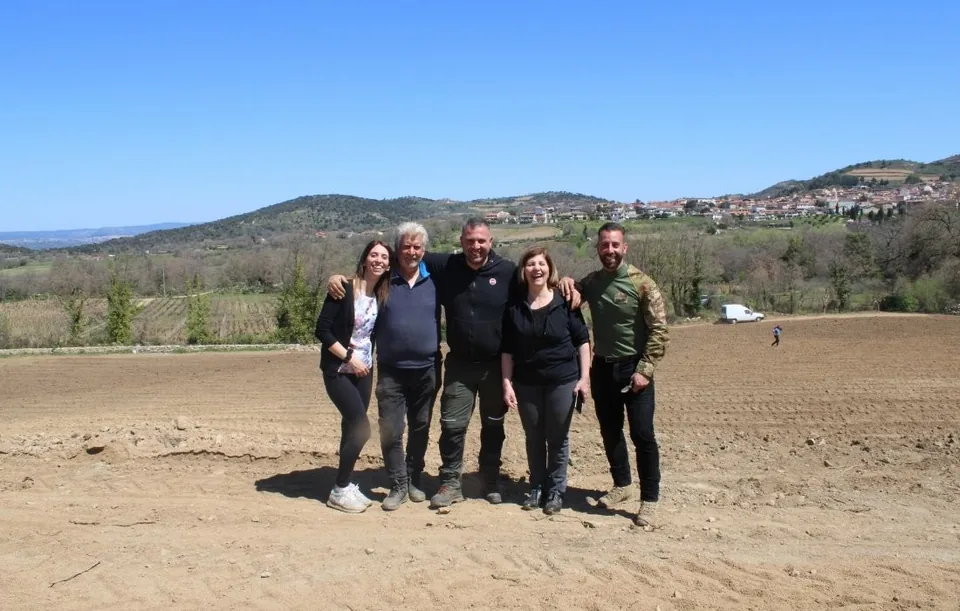
A nickname that became a winery
Mussennore is the nickname of Gesuino, the grandfather of the family that now runs the winery in Mamoiada, in the Barbagia. In 1976 he planted the vineyard at Palagorrai with Cannonau alone. The estate's own account then sets out a slow handover: the vineyard passed to his daughter Maria Antonietta in 1996, the company was formally founded by Pietro in 2016, and in 2021 the family presented itself publicly with its first labelled bottles.
Today Antonio, Francesco and Roberta work alongside their parents, Maria Antonietta and Pietro. For a buyer, the useful part of that sequence is its order: the vineyard came first and the company came forty years later, which is why the range is built around named plots rather than around a brand.
Ghirada, and why it appears on the label
The producer defines a ghirada as the plot of land whose grapes are picked and vinified separately from the others, and states that in the Mamoiada dialect the concept is very close to that of a cru: a delimited area that yields one particular wine. Each ghirada differs in soil, altitude and sun exposure, and the estate presents the name on the label as the precise origin of the grapes.
Palagorrai, the historic plot, lies less than two kilometres from the village at around 620 metres above sea level, faces east, sits on sandy soil and was planted in 1976 with Cannonau only; the estate gives about one and a half hectares in total, of which 10,270 square metres are under vine. A second plot, Conzimu, borders it. The family bought that land in the 1940s, farmed it as a vineyard until roughly the 1980s, cleared it, and has now replanted it — the source of the wine that carries its name.
What the denomination says, and what it leaves to the producer
Cannonau di Sardegna DOC is a regional denomination: under the production rules the grapes may come from anywhere in Sardinia, with a minimum of 85% Cannonau, while the "classico" designation is restricted to the provinces of Nuoro and Ogliastra and requires at least 90%. Three subzones are recognised — Oliena or Nepente di Oliena, Capo Ferrato, and Jerzu. Mamoiada is not one of them.
That gap explains the labels. A village with a strong identity and no subzone of its own communicates origin by other means: the plot name on the bottle, and membership of Mamojà, the association of Mamoiada growers founded in 2015, whose members subscribe to a charter of territorial principles. The producer describes it as around seventy growers and more than twenty wineries.
The rules also shape the range itself. For the Riserva, the DOC requires at least two years of ageing from 1 November of the harvest year, of which at least six months in wood, and a minimum of 13% total alcohol. The white and rosé sit outside the DOC under Barbagia IGT, whose production area includes Mamoiada; in that IGT the grape name Cannonau may not be used on the label, which is why a rosé made from Cannonau appears simply as Barbagia IGT. Nothing here is a quality judgement — it is the map a buyer needs when reading the range against a competitor's.
Discuss Mussennore for your market
The range presented by the estate covers Cannonau di Sardegna DOC, including a Riserva and plot-named reds, a rosé and a white from Granatza, the white variety of the Mamoiada area, both under Barbagia IGT. Tell us your country, your sales channel and the part of the range you have in mind. Enovia can check availability and current vintages with the producer and discuss technical documentation and samples with the parties involved.